



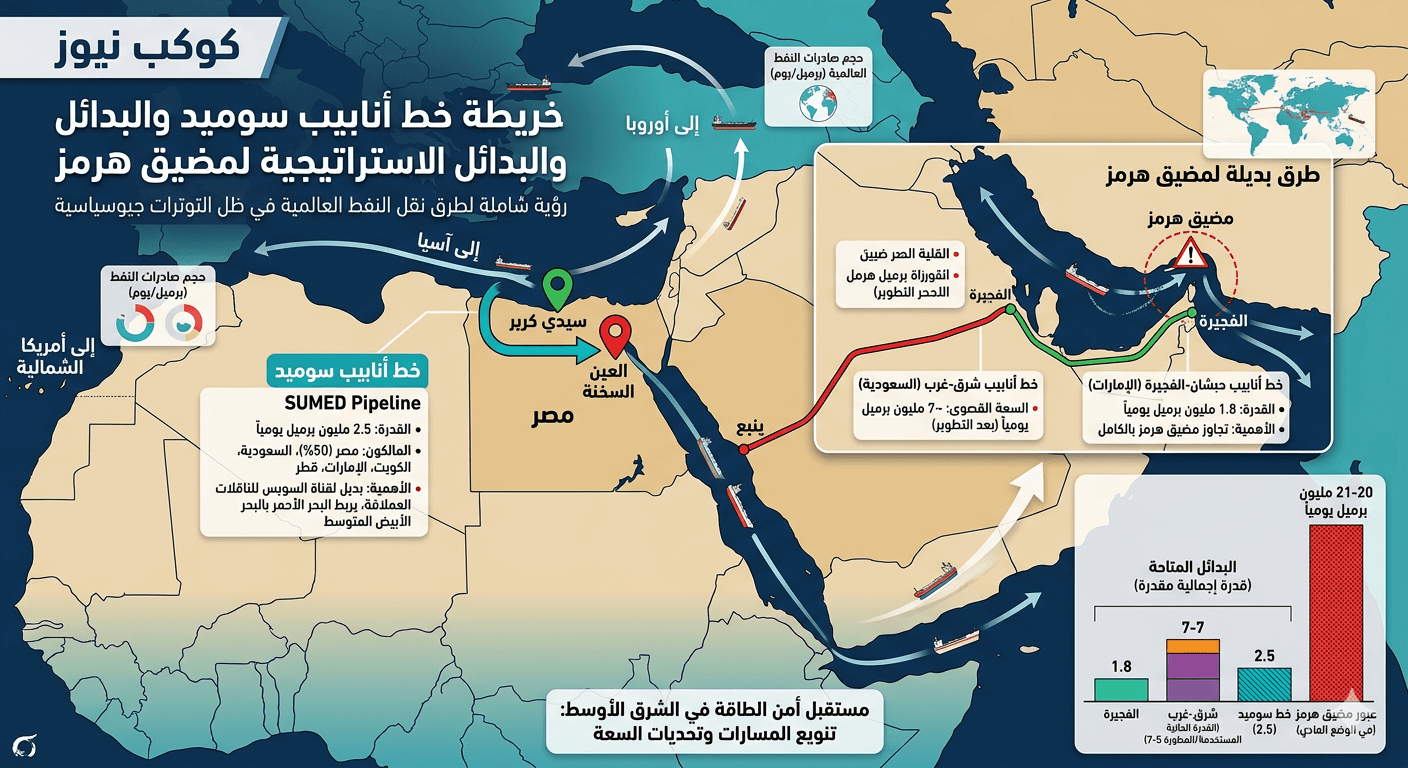
The Strait of Hormuz and oil exports represent a major point of tension in global energy markets, especially with the escalation of geopolitical risks in the Gulf and the possibility of disruption to maritime navigation.
The importance of the Strait of Hormuz for global energy
Ala the Strait of Hormuz The world’s most important oil and gas shipping route. 20 million barrels a day.—This is equivalent to one-fifth of global energy consumption. Most Gulf countries, such as Saudi Arabia, the United Arab Emirates, Kuwait and Iraq, are involved, making shutting it down or disrupting its navigation a direct threat to supplies and markets.
If the strait were to be closed even for several days, it would mean significant supply shortages, which could push the price of oil much higher.—Some predictions point to Rise Oil barrel price Above $100 or even $120150150 in the worst case scenario.
SUMED Oil LineIs it a real alternative?
SUMED Line Him. Egyptian Pipeline It connects the Red Sea to the Mediterranean Sea. 2.5 million barrels per day. It is mainly used to transport oil coming from the Red Sea to the Mediterranean for free re-export to European markets.
The question is, can this line be replaced? the Strait of HormuzIn fact, the answer Nope.—Not directly.SUMED cannot replace the Strait of Hormuz without an initial transport network to transport oil from the Gulf to the Red Sea, whether via pipelines such as the Eastern/Western Saudi Or others.
So Sumed Part of a variety of logistics alternatives But... Not an independent alternative. The vital sea corridor in the Gulf. In other words, Sumed can help shift some cargoes, but its ability to fully compensate for oil flows through Hormuz remains limited.
The Influence of Hormuz on Saudi Arabia and the Gulf States
Gulf states rely heavily on the Strait of Hormuz and oil exports to support their budgets.
Saudi Arabia
Saudi Arabia has several alternative pipelines that allow it to move oil to the Red Sea. East خطWest Line It can transport millions of barrels a day from the eastern fields to Yanbu on the Red Sea. Sumed To transfer some quantities to European markets.
But even with these networks, the ability to offset exports through the Strait of Hormuz is still complete. Limited—Especially in the event of a protracted crisis. Thus, the impact on Saudi energy exports and global oil prices remains significant.
Other countries such as Qatar
Qatar relies heavily on a hormone Strait in export. LNG natural gasIn the event of its closure, gas transport will be more complex than oil, where there are no many marine pipeline systems to transport gas in large quantities, and therefore, Qatar is much stronger. If traffic stops in the strait.
States such as Kuwait and Iraq are highly dependent on the passage of oil through a symbol also, without strong alternatives, making them more vulnerable to any possible closure.
Reflections on world oil prices
Navigation disrupted the Strait of Hormuz The risk of market shortages is raised, which is immediately reflected in prices; in the previous similar crises, oil prices rose significantly when the market experienced instability in the Middle East supply, and the expectations of some analysts reached. $100 or higher for the barrel. In case the malfunction continues.
Oil prices are affected not only by actual supply, but also by concerns about the ongoing crisis, where investors raise price assessments to cover supply risks
Conclusion
See? Planet News That's Sumid's line. It can contribute limits to the crossroads of the Hems Strait, but it's... Not an independent alternative. This is the strategic corridor.
Saudi Arabia has alternative lines that help reduce dependence on the Strait.
Other States like Qatar, Kuwait and Iraq It is highly dependent on the movement of the Strait and difficult to compensate.
Closure of the Horms Strait directly affects World oil prices It may lead to much higher levels as a result of the shortage of supplies. Any disturbance in the Hormuz Strait and oil exports immediately reflects global energy prices.






One comment.